
Abdominal Bloating, Distension, and Abdominal Phrenic Dyssynergia is a very popular topic when I give presentations and one that seems to be gaining a lot of momentum in the healthcare world.
Abdominal-phrenic dyssynergia is a GI disorder that results when the abdominal muscles relax when they should be contracting, and the diaphragm contracts when it should be relaxing during digestion or changes in the pressure of the lumen.
Bloating is the hypersensitive sensation to lumen changes without girth changes. This is what makes you feel like you just ate an entire turkey, but don’t have the physical abdominal changes that go along with it.
Distension is the physical, measurable change of the girth of the abdomen with the hypersensitive sensation of the lumen.
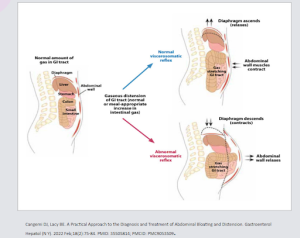
In a normal visceral somatic reflex, the diaphragm raises up, relaxing. The anterior abdominal muscles have more tone and contract to contain the distention.
In an abnormal visceral somatic reflex, the diaphragm lowers, contracting. The abdominal wall relaxes, causing more abdominal distension. Over time, the diaphragm becomes less mobile due to over-recruitment.
In an article from 2017, Bloating and Abdominal Distension: Old Misconceptions and Current Knowledge, they looked at unhealthy people with colonic gas. In normal people, the diaphragm relaxes, the anterior abdominal wall increases its tone, controlling abdominal distention. But in people with abdominal dyssynergia, the presence of gas caused increased abdominal distension with a contraction of the diaphragm, and relaxation of the internal oblique muscles.
Interestingly, if we assume people had pain associated with gas, and compare it to an article by Kohler in 2012 that looked at the movement of the diaphragm in people with low back pain, we find that the diaphragm begins to act as a postural muscle in the presence of pain and loses its mobility under load.
What’s this all mean for us as physical therapists?
The reduced mobility of the diaphragm causes the intercostals and lower ribs to become stiff, while the abdominal wall is relaxing resulting in very uncomfortable bloating.
So what we need to consider in this population, is working on
- Down-training all of the stress mediators. Because as we know, we can’t intervene as well in a heightened system.
- We need to work on the neuro-motor control of the abdomen and diaphragm. Because people with this condition have a nervous system that isn’t firing appropriately and we need to figure out a way to get it to change.
My goal when I work with this patient population is to reduce over-activity of the diaphragm and obliques and then retrain them to fire appropriately.
There are 3 things that I work on with these patients:
- I want them to learn to fully relax their abdomen. This population tends to heavily belly breathe because the diaphragm isn’t functioning correctly. So we work on increasing rib mobility with breathing exercises in quadruped or forward leaning over a table, while also learning to fully relax their abdomen.
- We work on gently lifting their anterior abdominals toward their spine as they exhale to help the diaphragm relax.
- Once they are able to repeatedly complete steps 1 and 2 without compensations, we work on retraining this pattern into more functional positions such as sitting and standing. We also focus on creating a more optimal eating pattern and position to allow the digestive motor system to work more efficiently.
In addition to the movement system, we also have to think about all the other systems as well.
One big factor to consider is how much stress is someone under. The stress response is like your brain telling you you’re running from the hungry tiger that wants to eat you. And so your body pumps out all this cortisol and it makes your GI system go offline. As a result, the system becomes sluggish and inflamed and further feeds into this dyssynergia.
In a study by Hodges and his group, they looked at the interaction between local and systemic inflammation and how lifestyle and psychological factors influence tissue and musculoskeletal health. And they found, not unsurprisingly, that stress and other factors like it, can have pathological consequences. But they also found that interventions aimed at just one part of the puzzle, stress, sleep, or physical activity can positively affect the other systems.
Based on these findings then, there is no need to get ourselves or our clients overwhelmed trying to fix everything all at once. We just need to pick one thing. And it’s good if you let your client pick the one thing to change. Because when you try to change too many things too fast, it’s like throwing gasoline on the fire and they won’t be able to make the sustainable change.
Working with these types of patients can be challenging and require multiple ways of thinking about what is going on to come to a solution and help them resolve their symptoms.
Make sure to view the course on this subject: Abdominal Bloating, Distension, and Abdominophrenic Dyssynergia. There is a ton of great information found in this course. You can find it in the “Video Library” section of your subscription.
And as always, if you have questions you can pop them into the group chat, send me a private email, or join one of the mentoring sessions.
Resources
Bloating and Abdominal Distension: Old Misconceptions and Current Knowledge
Postural function of the diaphragm in persons with and without chronic low back pain